Thirty miles and two hundred years from the big city
A young George Washington was shot at here. A German religious commune built a town here from nothing in ten years, then sold the whole of it to a Mennonite blacksmith. The museum keeps both stories.
Washington slept here
The village of Harmony is situated where American Indian trails once crossed. A 21-year-old George Washington traveled those trails in 1753, at the direction of the lieutenant governor of the Virginia Colony. Washington led a delegation that included the wilderness guide Christopher Gist. Their mission was to find French forts built on land claimed by England, and ask them to kindly "get out." Per their journals, the night of November 30 was spent near Harmony on the north bank of the Connoquenessing Creek.
Washington almost died near here
Washington and Gist located the French forts, delivered the message to leave, and on their trip home met up, near present-day Harmony, with a native who offered a shortcut to the "forks of the Ohio." Washington and Gist eventually became suspicious of the guide's directions and intentions, all of which were confirmed when he stopped and shot at the duo. The shot missed. Washington had survived his first of many brushes with death — a musket ball that many consider the first shot of the French and Indian War.
The Washington 1753 Cabin on Main Street tells this part of the story.
Founding of Harmony
In 1789, as George Washington was becoming America's first president, a weaver and vine tender named George Rapp was causing religious trouble in Württemberg, part of present-day Germany. Rapp left the official Lutheran Church and gathered a large following by teaching pacifism, the separation of church and state, and the pending second coming of Jesus Christ. Declared a threat by the local government, Rapp called his followers to pool their resources and move to the "land of Israel" in the United States. In 1804 they purchased several thousand acres of land from Dettmar Basse, who had founded nearby Zelienople.
The first pilgrims arrived in September 1804 and, despite the approaching Pennsylvania winter, built nine log houses to live in until spring. On February 15, 1805, the town was officially formed with the signing of the Articles of Association. The name "Harmonie" was chosen to signify the members' desire to live in peace with each other, with their neighbors and with the land.
By 1805, some 90 families had followed Rapp to the Pennsylvania wilderness, pledging their worldly possessions to the Harmony Society. In return the Society would provide the necessities of life, as well as religious and educational instruction. Through hard work and a sense of purpose, the Harmonists thrived. The religious commune soon numbered a thousand members, with 2,000 cultivated acres and more than 100 buildings — houses, a church, barns, a grist mill, an inn, an oil mill, a blue-dyer's shop, a tannery, a woolen mill, a brick storehouse, a saw mill, a distillery, a brewery, a meeting house, and a bridge 220 feet long over the Connoquenessing Creek. They grew grain, corn, potatoes and grapes and produced wine, whiskey, flax, sweet oil from the poppy, and wool from the Merino sheep they raised. What the community didn't need was sold to the outside world. Thinking the end of time was near, the group adopted celibacy — a critical step toward its eventual extinction.
The Mennonite era
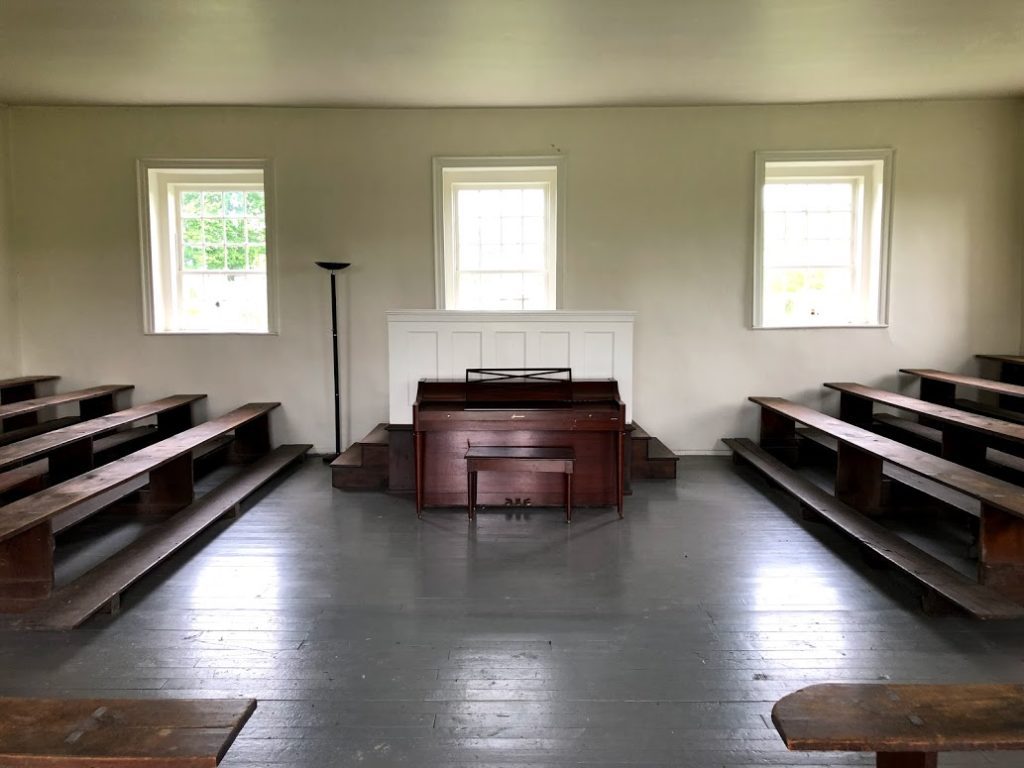
Searching for more land and better water transportation, the Harmonists decided to leave Harmony in 1814 and move to the Indiana Territory, where they founded New Harmony. Their advertisement for 9,000 acres of land and 130 buildings caught the eye of Mennonite Abraham Ziegler, a farmer and blacksmith from Lehigh County. Ziegler led a group of German-speaking Mennonites from eastern Pennsylvania to Harmony, where they began resettlement. The Harmonists retained ownership only of their cemetery at the edge of Harmony.
While the Mennonite families stayed in the area, intermarrying with members of other faiths, the Harmonists did not stay in Indiana. In 1824 they moved back to Pennsylvania, founding Economy on the Ohio River just 22 miles from their original home in Harmony. The Society dissolved in 1905, and is commemorated by Old Economy Village in Ambridge. The Mennonite community in Harmony lasted until 1904, by which time the town had sold more and more individual lots as outside people moved in.
The Harmony Museum
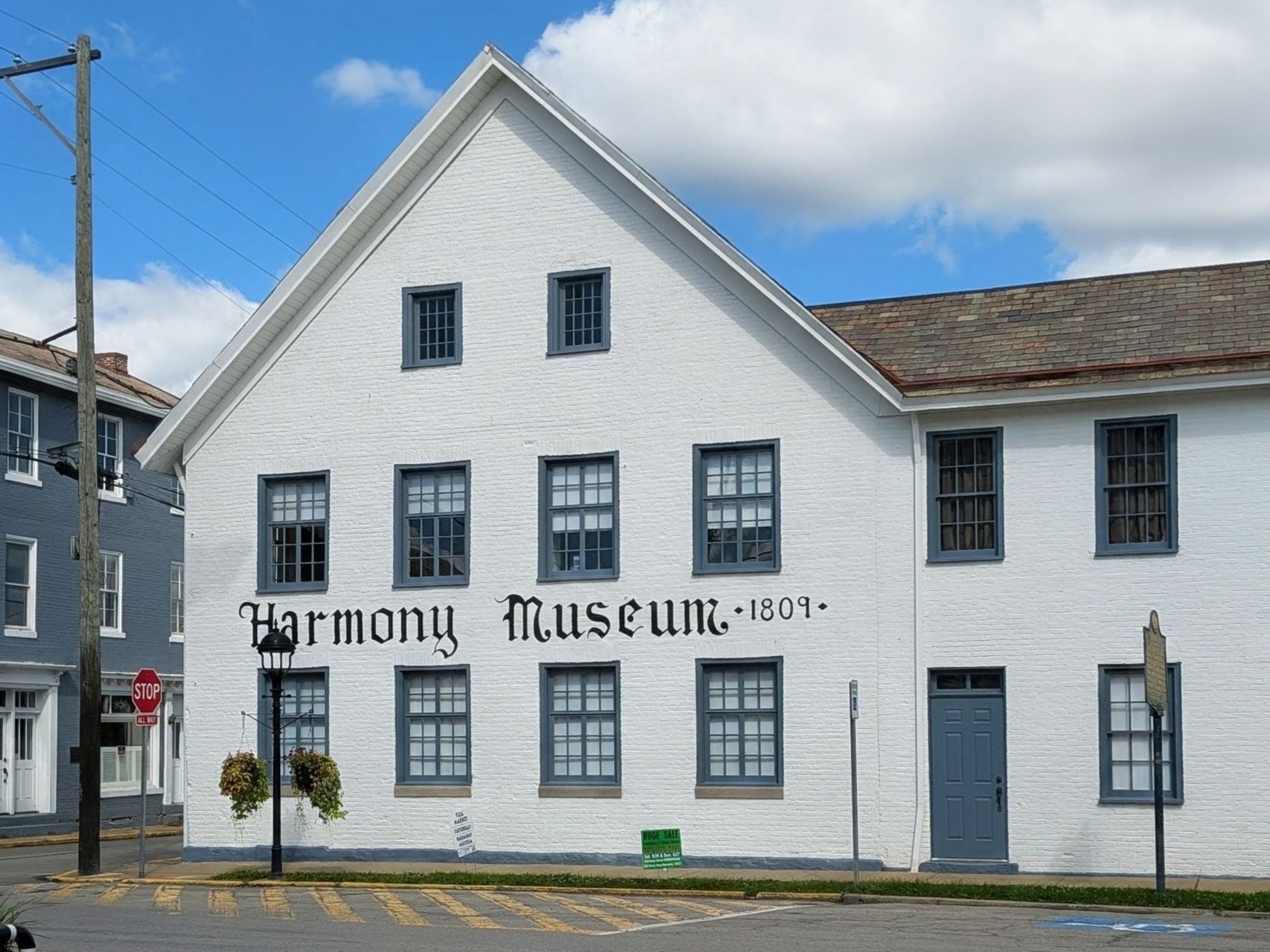
Historic Harmony was organized in 1943 and operates the Harmony Museum. It interprets more than 260 years of area history with presentations that include Washington's 1753 mission, the Harmonists, the Mennonites, and a fine collection of sporting rifles made by 19th-century Harmony gunsmith Charles Flowers. Historic Harmony preserves nine sites, including the 1809 main museum building, the 1805 Harmonist-Ziegler Barn, the 1812 Wagner/Bentel Haus, the Harmonist cemetery, and the 1825 Mennonite Meetinghouse, which is listed on the National Register of Historic Places.
The Harmony Line
From 1908 to 1931 the maroon-and-gold trolleys of the Pittsburgh, Harmony, Butler & New Castle Railway ran through here to the city. A longer read.
Read the storySee it on foot
Twenty-eight stops through the Harmonist and Mennonite town, on a map that works on your phone.
Walking tour